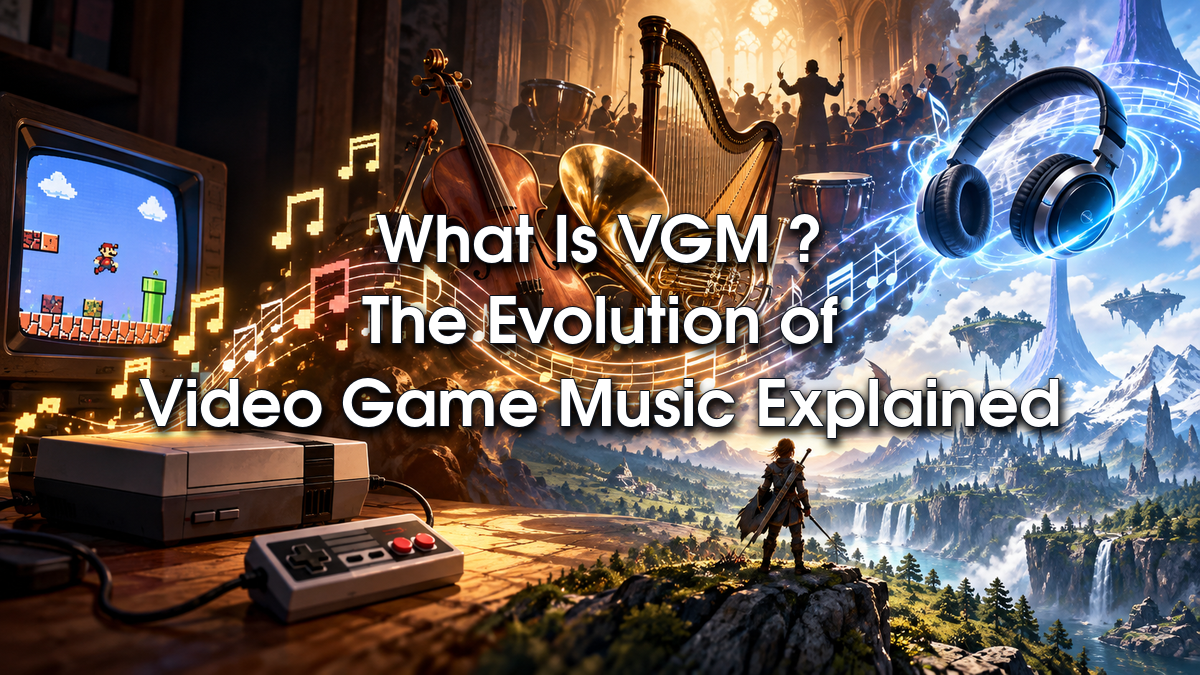
What Is VGM? The Evolution of Video Game Music Explained
VGM, short for video game music, covers every piece of music composed or arranged for games, from the first arcade beeps of the 1970s to modern orchestral and adaptive scores. This reference page explains what VGM means, how it evolved through chiptune, CD audio and concert halls, how adaptive music works and where to begin listening with a starter list of albums. It also covers adaptive scores and indie composers.
Key Takeaways
- What VGM means and what it includes
- How arcade beeps grew into chiptune VGM on the NES and Game Boy
- How CD audio and orchestras changed VGM
- How adaptive scores, concerts, and awards shaped modern VGM
What Does VGM Mean in Gaming?
VGM is short for video game music, the umbrella term for every note composed or arranged to play inside a game. It covers title screens, battle themes, shop jingles, and the menu clicks your brain somehow memorizes. Fans also use it for the albums, concerts, and remixes that grow out of those tunes, which is why VGM communities feel so lively!
VGM differs from film scoring in one big way: it has to loop, react, and survive being heard hundreds of times. Video game composers therefore write melodies that stay catchy on the fortieth repeat. A video game OST, short for original soundtrack, is the album release of that work, and a great VGM album can be replayed for years. Here is what VGM usually includes:
- Looping background tracks that play for minutes without tiring the listener
- Short stingers for victories, defeats, and item pickups
- Interface sounds such as menu clicks and level-up chimes
- Vocal songs, from ending themes to fully sung anthems
How Did Beeps Become Chiptune?
Welcome to the first movement, where music barely exists! Pong, released by Atari in 1972, offered little more than blips when the ball hit a paddle. Then Space Invaders arrived from Taito in 1978, designed by Tomohiro Nishikado, with a four-note bass loop that sped up as the aliens descended. That rising tempo made players sweat, and early VGM had found its first big trick.
Pac-Man, released by Namco in 1980, followed with a cheerful opening tune by Toshio Kai that set the mood before you ate a single dot. Arcades were noisy, so these short melodies had to cut through the chaos, and they did. That is how the VGM tradition of the catchy hook was born. The real explosion came with home consoles. The Nintendo Entertainment System, known as the Famicom in Japan, had a sound chip with two pulse-wave channels, a triangle channel, a noise channel, and a sample channel. Chiptune VGM was born inside that tiny palette.
Koji Kondo squeezed Super Mario Bros. (1985) and The Legend of Zelda (1986) into those few channels, while Nobuo Uematsu gave Final Fantasy (1987) its sweeping melodies. The Game Boy followed in 1989 with four channels, and Hirokazu Tanaka’s arrangement of the folk tune Korobeiniki turned Tetris into a hummable classic. On the Sega Mega Drive, called the Genesis in North America, Yuzo Koshiro layered club-style beats into Streets of Rage in 1991. That scrappy, chip-made sound is now called chiptune, and plenty of fans still prefer it to anything else!
When Did Video Game Music Go Orchestral?
Then the compact disc stepped onto the stage, and the sound got enormous! Discs gave developers far more storage, and that room let video game composers think like film composers. Final Fantasy VII reached the PlayStation in 1997 with a cinematic Nobuo Uematsu score, and its villain theme “One-Winged Angel” became a concert favorite.
In 2001, Halo: Combat Evolved arrived with a score by Martin O’Donnell and Michael Salvatori, built around soaring strings and monk-like chants that made a sci-fi shooter feel ancient and sacred. Orchestral VGM is now the norm. Today, studios record live orchestras and choirs as a matter of course, and some fans even collect a favorite video game OST on vinyl. Classic VGM and modern cinematic scores now share one huge, glorious family tree!
How Does Adaptive Music Work?
Film music follows a fixed timeline, but players control their own pace, so VGM had to learn to bend. In 1991, LucasArts introduced iMUSE, an interactive music system developed by Michael Land and Peter McConnell, which debuted in Monkey Island 2: LeChuck’s Revenge. Instead of cutting from one track to the next, it shifted the music smoothly as the action changed.
Modern games push the idea further. Adaptive VGM can add drums as enemies close in, strip back to a lone piano when you explore, or change key when you enter a new region. The composer writes the pieces, and the game engine conducts them in real time. You, the player, are holding the baton!
From Indie Stages to Concert Halls
Small teams have changed the scene too. Toby Fox composed the music for Undertale (2015) himself, and Lena Raine’s score for Celeste (2018) became a streaming favorite. Indie VGM releases now often appear on streaming services, so fans can hear a soundtrack without buying a disc.
The concert hall has noticed. Video Games Live, created by Tommy Tallarico and Jack Wall, began with a 2005 show at the Hollywood Bowl, and Distant Worlds: Music from Final Fantasy, conducted by Arnie Roth, started touring in 2007. Awards followed: Christopher Tin’s “Baba Yetu” from Civilization IV won a Grammy in 2011, and Austin Wintory’s Journey score earned a Grammy nomination in 2013. In 2023, the Grammys gave video game scores their own category, and Stephanie Economou won the first trophy for Assassin’s Creed Valhalla: Dawn of Ragnarok. VGM has officially taken a bow!
How Do You Start Listening to VGM?
Ready to build a playlist? Start with this timeline of starter VGM albums, which walks through the story in order. Each one shows a different era at its best.
- Super Mario Bros. – Koji Kondo’s bouncy 1985 themes prove how much personality a few channels can carry
- Streets of Rage – Yuzo Koshiro’s 1991 tracks bring club beats to a Genesis cartridge
- Final Fantasy VII – Nobuo Uematsu’s 1997 score is a gateway to epic, emotional VGM
- Halo: Combat Evolved – the 2001 soundtrack shows what choirs and strings can do for a shooter
- Journey – Austin Wintory’s 2012 score follows the player through every step of the trip
- Undertale – Toby Fox’s 2015 songs show how one person can build a whole musical world
Once you find a favorite, follow its composer and see where they went next. Great video game composers often move between consoles, studios, and genres, so one name can lead you to a dozen new albums.
Conclusion: Why VGM Deserves a Spot on Your Playlist
From a single beep in 1972 to sold-out halls full of strings, VGM has traveled further than almost any other musical form. It began as a technical limit, turned into an art, and now fills concerts, award shows, and streaming libraries. Every era in this story still has something worth hearing, whether you love chiptune crunch or cinematic sweep.
So pick one album from the list, press play and let the music tell the story. Tell a fellow VGM fan which theme you picked, and watch how quickly a few notes bring back an entire adventure. Every era of VGM has something worth hearing, and the next great track is waiting for you.